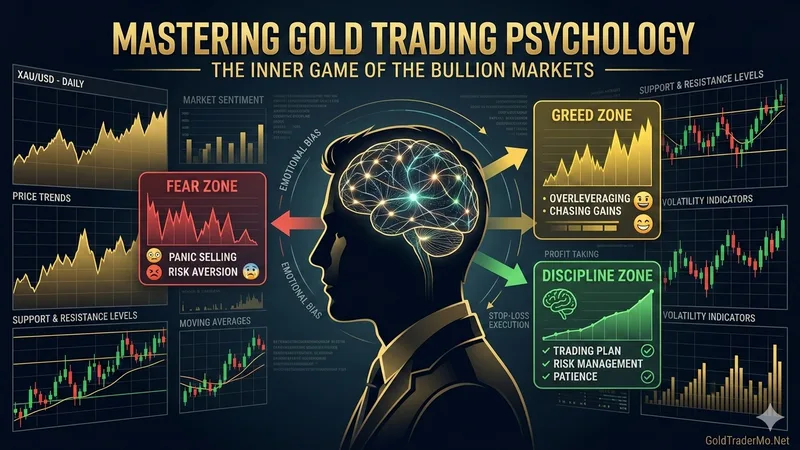
If you want long-term consistency in XAUUSD, trading psychology gold traders practice every day matters more than finding one “perfect” setup. As of February 28, 2026, data indicates gold can move aggressively (with a 14-day ATR around $173.9), and that level of volatility can amplify fear, greed, and impulsive decisions faster than most traders expect.
Full Disclosure: Gold Trader Mo operates a signals channel. This guide is educational — always do your own research.
Trading Psychology Challenges Gold Traders Face#
Why XAUUSD volatility creates emotional pressure#
Studies suggest when an instrument has wide daily ranges, traders feel pressure to act quickly, often before their plan is fully validated. In gold, a move that looks “small” on a higher timeframe can still be large enough intraday to trigger panic exits or impulsive entries.
That is why many traders who do well in slower pairs struggle in XAUUSD. The issue is often not strategy quality. It is emotional execution under pressure, and understanding trading psychology helps gold traders stay consistent.
The science behind trading emotions in fast markets#
Data indicates many retail traders use leverage that turns minor execution errors into meaningful account drawdowns. This creates a feedback loop: one loss causes stress, stress causes poor decisions, and poor decisions create more losses.
If you are still building your foundation, review beginner's guide to gold trading and complete gold trading guide for beginners. A stable technical process reduces emotional noise.
Research in high-stress decision environments suggests cortisol can rise during uncertainty and rapid price movement. In trading contexts, studies suggest spikes around 20–40% during volatile periods may reduce prefrontal clarity, which is the part of your brain used for planning and impulse control.
In practical terms, this can look like skipping your checklist, widening stops, or forcing entries after missing a move.
Most traders already know revenge trading is harmful. But stress chemistry can override logic unless you build a routine that interrupts the reaction cycle. That is why elite execution is more behavioral engineering than motivation.
Your goal is not to “feel nothing.” Your goal is to create repeatable systems that work even when you feel pressure.
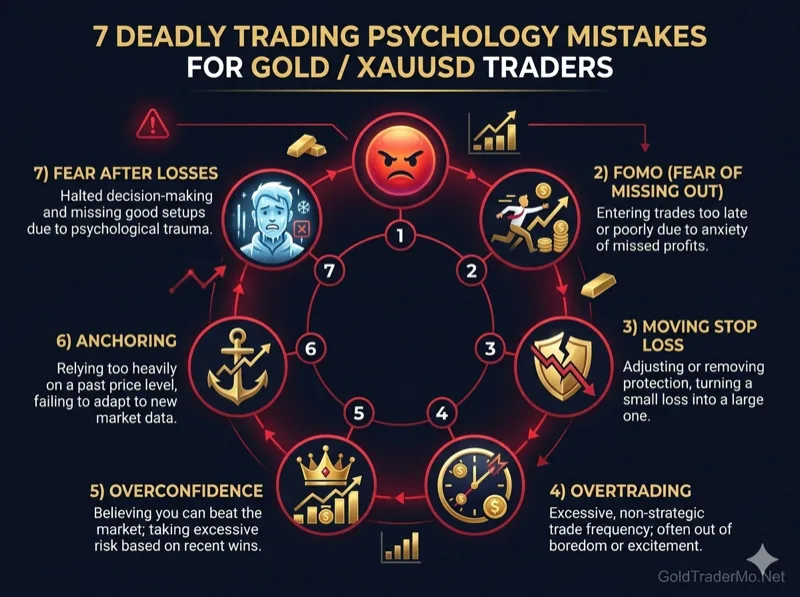
7 Psychology Mistakes Gold Traders Make Repeatedly#
1. Revenge trading after a stop-out — Data from trader behavior studies suggests losses are often followed by risk-seeking decisions. The fix is simple and strict: take a 15–30 minute cooling-off period after a loss that triggers emotional urgency.
A pause is not weakness. It is part of risk management.
2. FOMO chasing breakouts without confirmation — Gold often prints explosive candles around key levels. Traders jump in late, then get trapped on the retrace. A better process is to wait for pullback confirmation and pass your full checklist before entry.
This is especially relevant if you trade around momentum styles like 5-minute gold scalping strategy.
3. Moving stop losses to avoid being wrong — A moved stop is usually an emotional decision, not a strategic one. Treat your stop as sacred once the trade is live. If your setup requires a wider stop, define it before entry.
Automation helps here: set SL/TP immediately and avoid manual edits unless your plan explicitly allows a rule-based adjustment.
4. Overtrading high-impact news windows — Many traders overtrade around NFP/FOMC and call it “opportunity.” For most developing traders, it is uncontrolled variance. Use a no-trade window 30 minutes before and after major releases unless your strategy is explicitly built and tested for news.
5. Overconfidence after a winning streak — Winning can be as dangerous as losing if it makes you increase size impulsively. Keep a hard 1% risk cap regardless of recent performance.
6. Recency bias after a few unusual sessions — Three strong bullish days do not guarantee the next day’s direction. Keep a 20–50 trade sample and evaluate process quality over that larger set.
7. Confirmation bias in analysis — Before entering, list three reasons your trade could fail. This one habit forces a balanced read and reduces selective interpretation.
Building Your Pre-Trade Discipline System#
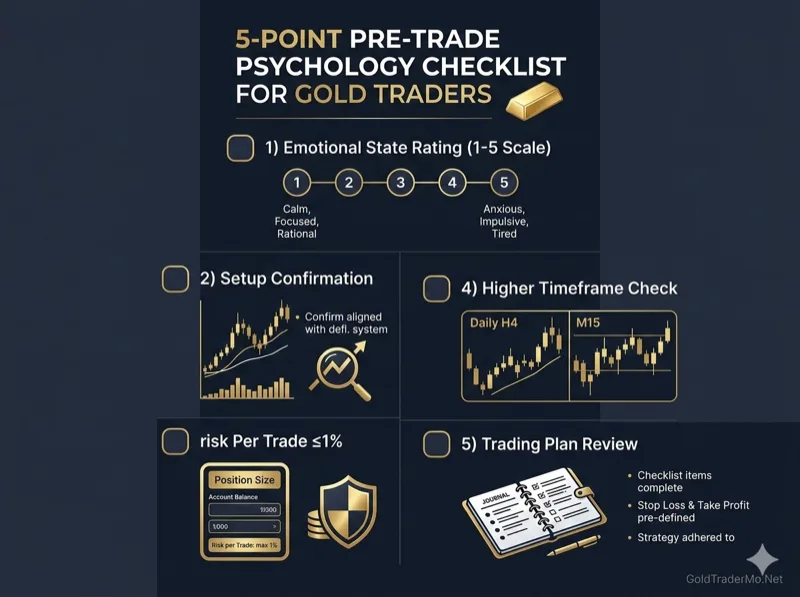
The 5-point gate before every trade#
Use one checklist for every setup, no exceptions:
- Volatility context checked (ATR/session conditions)
- Setup confirmation matches written playbook
- Position risk is ≤1% of account
- Emotional state rated 1–5 (only trade at stable levels)
- Higher timeframe bias reviewed first
If one item fails, skip the trade.
Position sizing clarity reduces emotional stress#
Many discipline problems start with wrong size. For gold, keep position math explicit and standardized in your notes. For standard lot calculations, use $10/pip as your base pip value reference in your risk framework.
When your size is correct, normal variance feels manageable. When size is too large, even good setups feel psychologically unbearable.
Checklist compliance is your real edge#
Rule-based traders generally show more stable performance than fully discretionary traders in high-volatility conditions. Data indicates this can translate into higher consistency over time.
Your edge is not just entry signal quality. It is the consistency of decision quality under stress.
For broader context on execution behavior in fast markets, study gold scalping strategies guide.
Mental reset and 3-strike rules for daily discipline#
Use 4-4-4-4 breathing for 2–3 minutes before active trading and 4-7-8 breathing after a loss or missed move to interrupt urgency and re-center decision quality. Research suggests 20–30 minutes of cardio can help lower stress markers and improve focus quality, while 5–10 minute hourly breaks reduce fatigue during 4–6 hour focused trading windows.
Set hard rules before market opens: 3 consecutive losses = stop for the day, daily loss limit around -1%, daily gain lock around +2%, and maximum 3–5 trades per session. The 2% rule mindset (or stricter 1% for active traders) reframes losses as operating cost, and a written script like “reduce size by 50% after one rule break, stop 60 minutes after two, end session after three losses” removes negotiation when emotions are elevated.
🎓 Want structured gold trading education? GTMO Trading School is now open — video courses, live trading sessions, and direct mentorship from Mo. Join GTMO School →
The Trading Journal That Changes Everything#
What to log after each trade#
A useful journal is short, structured, and honest. Include:
- Screenshot of setup
- Entry and exit reasons
- Emotional state (fear/greed/confidence)
- Process grade (A–F)
- One lesson for future execution
This turns each trade into feedback, not just outcome.
Weekly review to catch hidden behavior patterns#
Studies and industry data suggest routine review improves performance by exposing repeat mistakes. A weekly process audit can show whether losses come from strategy limits or discipline breaks.
Use these prompts:
- Did I follow my setup rules?
- Where did emotion alter my process?
- Was actual R:R aligned with planned R:R?
- What one rule should I tighten next week?
If you only track money, you miss behavior drift. A trade can make money and still be low quality. Grade the process first, then evaluate outcomes, because over time cleaner process tends to produce cleaner equity curves.
Building an Elite Trader Daily Routine#
Morning structure before the first chart#
A practical routine used by many high performers:
- 6:00 AM: short meditation + journal
- 6:20 AM: exercise
- 7:00 AM: market prep, only 3 setups max
- Pre-session: breathing + checklist review
Good routines reduce decision fatigue later in the session.
Trade in defined windows, not all day#
Constant screen exposure often leads to forced trades. Use planned windows aligned with your strategy and liquidity conditions. Outside those windows, review or step away.
This protects both your attention and your execution quality. Before finishing, document:
- Best trade (why it was good)
- Worst trade (what rule failed)
- One process improvement for tomorrow
Consistency comes from repeated small corrections, and mastering your trading psychology as a gold trader is what makes those corrections stick.
Frequently Asked Questions#
Is psychology really more important than strategy in gold trading?#
Both matter, but data indicates poor psychology can destroy even a strong strategy through execution errors. In fast markets like XAUUSD, discipline often determines whether the edge survives live conditions.
How do I stop revenge trading after two losses?#
Use a mandatory cooling-off timer (15–30 minutes), do one breathing cycle, and write one journal line before taking any new position. If losses continue, apply the 3-strike stop-day rule.
What is a realistic risk per trade for gold beginners?#
Most developing traders do best with 0.5% to 1% risk per trade while they build consistency. Larger risk can make normal variance emotionally hard to handle.
Should I trade during NFP or FOMC releases?#
If you do not have a tested news-specific plan, the safer approach is often to stand aside 30 minutes before and after the release. Volatility can invalidate normal execution assumptions.
How long does it take to build discipline?#
There is no fixed timeline, but many traders see noticeable improvement after 4–8 weeks of strict checklist compliance and weekly journal review.
Can signals replace psychology work?#
No. Signals can support idea flow, but execution discipline remains your responsibility. Position sizing, rule-following, and emotional control still decide outcomes.
Final thoughts: discipline is a trainable skill.
The goal is consistency, not perfection. As of February 28, 2026, market conditions continue to reward disciplined process over emotional prediction. Gold volatility will test every weak rule in your plan.
If you want longevity, simplify your system, reduce position stress, and execute what you already know.
Build your next 30 days with clear priorities: For the next month, focus on:
- One setup family
- One checklist
- One journal template
- One weekly review block
That is enough to transform your results if you stay consistent.
For additional education, read gold scalping strategies guide and best gold trading signals 2026, then compare ideas against your own written rules.
One of the most common trading psychology challenges for gold traders is breaking rules after a single emotional trigger, so keep your checklist visible during live sessions.
Start Your Gold Trading Journey
🎓 GTMO Trading School — Structured courses, live sessions, exclusive strategies 👉 Join School Now
🆓 Free Daily Signals — XAUUSD setups delivered to Telegram 👉 Join @gtmo Free Signals
💬 Need Help? — Direct support from the team 👉 @gtmobest on Telegram
📺 YouTube · 📸 Instagram · 🌐 GoldTraderMo.Net
⚠️ Risk Disclaimer: Trading gold (XAUUSD) involves substantial risk of loss and is not suitable for all investors. Past performance does not guarantee future results. Always use proper risk management, never risk more than you can afford to lose, and consult a qualified financial advisor before trading.
This article is for educational purposes only and does not constitute financial advice.