gold trading has become one of the most searched trading topics in 2026 because gold (XAUUSD) moved from roughly $2,942 in February 2025 to around $5,195.30 on February 26, 2026, a gain of about 76% in twelve months. For beginners, this market can look confusing at first: strong trends, sharp reversals, large intraday candles, and nonstop opinions online. This guide gives you a practical path from zero knowledge to structured execution, with real numbers for lot size, pip value, margin, session timing, strategy selection, and risk control.
Full Disclosure: Gold Trader Mo operates a signals channel. This guide is educational, not financial advice — always do your own research and consult a qualified financial advisor.
Why Gold Trading Is One of the Best Markets in 2026#
Macro Trends Are Driving Unusual Opportunity#
Gold in 2026 is not moving randomly. Several macro forces are lining up at the same time: heavy central bank buying (over 1,000 tonnes in 2025) (World Gold Council), ongoing de-dollarization narratives, tariff-related uncertainty, and a more dovish tone from major central banks when inflation softens. These are exactly the kinds of drivers that create sustained trends instead of short-lived spikes.
For beginners, trend persistence matters. It is easier to learn when the market respects major levels and directional momentum than when price is stuck in tiny ranges. In 2026, gold has shown both high momentum and repeated retests of key zones, which gives new traders cleaner structure to practice.
Another reason this environment is educational is narrative clarity. When traders can map a move to a macro theme, it becomes easier to create a checklist: “Is the move risk-off? Is the dollar weakening? Are yields falling?” You do not need to predict every macro release, but you should learn how broad themes affect intraday behavior. This habit reduces emotional reactions and improves patience around major levels.
Volatility Is High Enough to Matter, But Structure Is Still Tradable#
Gold’s 14-day ATR near $173 tells you daily movement is significant. That means opportunity exists even for small position sizes. A beginner trading 0.01 lot can still see meaningful percentage growth in a disciplined month, while keeping absolute risk small.
At the same time, market structure still works. Support near $5,149 and $5,100, plus resistance around $5,205-$5,220, gives objective levels for planning trades. When volatility is high but technical structure remains usable, beginners can practice rule-based trading instead of guessing.
Liquidity and Participation Support Better Execution#
Daily gold market volume reached around $227 billion in 2024 (World Gold Council), up roughly 39% year-over-year. High liquidity generally supports tighter spreads and more reliable execution during active sessions, especially London and New York overlap.
This matters for learning because poor fills can hide whether your strategy is good or bad. In liquid markets, your result more closely reflects your decisions, not random broker friction. That is why XAUUSD remains one of the top instruments for education-focused traders in 2026.
What Is XAUUSD and How Does Gold Trading Work?#
XAUUSD Means Gold Priced in US Dollars#
XAU is the symbol for one troy ounce of gold, and USD is the US dollar. When XAUUSD rises, gold is becoming more expensive in dollar terms. When XAUUSD falls, gold is becoming cheaper in dollar terms.
Most beginners trade XAUUSD as a CFD or spot contract through MT4/MT5 brokers, not by buying physical metal. You are speculating on price direction, not taking delivery of bars.
How Profit and Loss Are Calculated#
Your P/L depends on three things: entry price, exit price, and position size (lot size). On XAUUSD, one pip equals a $0.10 price movement (10 points), while the smallest quoted increment is $0.01 (1 point). The pip value depends on lot size:
| Lot Type | Size | Pip Value |
|---|---|---|
| Standard (1.00) | 100 oz | $10/pip |
| Mini (0.10) | 10 oz | $1/pip |
| Micro (0.01) | 1 oz | $0.10/pip |
If you buy 0.01 lot and price moves +50 pips (=$5.00), your gross gain is about $5. If it moves -50 pips, your gross loss is about $5, excluding spread and commissions.
Why Beginners Should Learn Market Mechanics First#
Many new traders jump directly to indicators and signals. That is backward. You should first understand contract size, pip value, spread costs, margin requirement, and how leverage magnifies both gains and losses.
If you skip basics, you can be right on direction and still lose money due to oversized positions or poor cost control. Build this foundation once, and every strategy you test becomes safer and easier to evaluate.
Treat market mechanics like learning the brakes before driving fast. If you know exactly what 0.01 lot means, how much your stop costs, and how spread affects breakeven, you can make calm decisions during volatility. Beginners who master mechanics early usually avoid the costly cycle of account blowups and repeated restarts.
Essential Gold Trading Terminology Every Beginner Must Know#
Core Terms You Will Use Daily#
You need fluency in basic terms before real trading:
- Pip: Standard unit of price movement for XAUUSD, equal to $0.10 (10 points). The smallest quoted increment ($0.01) is called a point.
- Lot: Position size unit (1.00, 0.10, 0.01).
- Spread: Difference between bid and ask price.
- Leverage: Borrowed exposure ratio, such as 100:1 or 500:1.
- Margin: Capital required to hold a leveraged position.
- Stop Loss (SL): Predefined loss exit.
- Take Profit (TP): Predefined profit exit.
Without these terms, trade analysis becomes impossible.
Practical Price Language for Chart Reading#
Gold traders often discuss levels in both dollars and pips. Example: “Gold dropped from 5,220 to 5,170,” which is a $50 move or 500 pips. Both descriptions are correct; context matters.
Beginners should normalize this translation quickly. If your stop is “$5 away,” that means 50 pips. If your plan says “50 pips stop,” that means $5.00. Confusing these units leads to major risk errors.
Session, Volatility, and News Vocabulary#
You should also understand session language:
- Asian Session: Lower volatility, often range behavior.
- London Session: Volatility expands, breakout potential rises.
- New York Session: News-driven momentum can accelerate.
- Overlap (London-New York): Peak liquidity and movement.
And event language:
- NFP, CPI, FOMC: High-impact US releases that can move gold sharply.
- Slippage: Fill price differs from requested price.
- Fakeout: Breakout fails and reverses quickly.
How to Calculate Margin, Lots, and Position Sizes#
Margin Basics With Current Price Examples#
Margin required is roughly contract value divided by leverage. At gold price near $5,200:
| Lot | Gold Price | Leverage | Margin Required |
|---|---|---|---|
| 0.01 | $5,200 | 100:1 | $52 |
| 0.10 | $5,200 | 100:1 | $520 |
| 1.00 | $5,200 | 100:1 | $5,200 |
| 0.01 | $5,200 | 500:1 | $10.40 |
Leverage lowers margin required, but does not reduce risk per pip. Risk is controlled by lot size and stop distance.
Position Size Formula Every Beginner Should Memorize#
Use this simple formula:
Position Size = Risk Amount / (Stop Distance in Pips × Pip Value per Unit)
Example with $500 account:
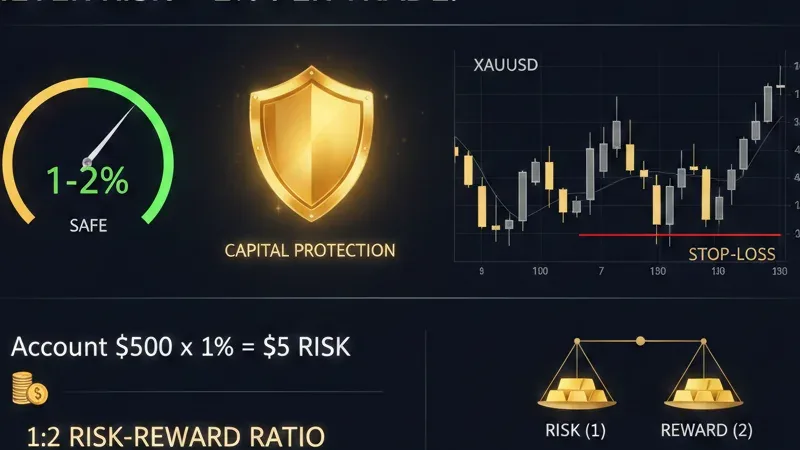
- Risk per trade = 1% = $5
- Stop loss = 50 pips
- Pip value at 0.01 lot = $0.10/pip
- Risk at 0.01 lot for 50 pips = $5
So max size is 0.01 lot for this setup.
If your stop needs to be wider because ATR expands, your lot size must come down. For example, if the same $500 account still risks $5 but stop widens to 100 pips, then 0.01 lot would risk $10, which is too high. You must cut size to 0.005 equivalent (or skip if broker does not support that granularity). This single adjustment protects you when volatility spikes.
Ready-to-Use Position Sizing Table#
| Account Balance | 1% Risk | Risk at 50-pip SL | Max Lot |
|---|---|---|---|
| $500 | $5 | $5 | 0.01 |
| $10,000 | $100 | $100 | 0.20 |
| $50,000 | $500 | $500 | 1.00 |
This table assumes a 50-pip stop and the $0.10/pip micro-lot convention. If your stop doubles, your lot size should halve.
Step-by-Step: How to Place Your First Gold Trade#
Step 1: Build a Pre-Trade Checklist#
Before clicking buy or sell, confirm:
- What is the higher timeframe trend (H4/D1)?
- What level are you trading from (support/resistance/retest)?
- Where is invalidation (SL)?
- What is your TP and risk-reward ratio?
- Is there major news in the next 30-60 minutes?
This checklist prevents emotional entries.
Step 2: Execute With Smallest Live Size#
Open MT4/MT5, select XAUUSD, and start with 0.01 lot. Define SL and TP before execution, not after. If your setup requires a very wide stop, reduce size or skip the trade.
For your first month live, treat every trade as a data point. Your goal is not “maximum profit,” but process consistency.
Step 3: Journal Every Trade Like a Professional#
After each trade, record:
- Setup type (trend, breakout, retest)
- Session and time
- Entry, SL, TP, result in R
- Screenshot before and after
- One lesson learned
A journal turns random activity into measurable improvement. If you want a faster launch framework, review How to Trade Gold XAUUSD: Beginner's Quick Start Guide and convert it into your personal checklist template.
At the end of each week, summarize journal data in one page: best setup, worst setup, most common mistake, and one process change for next week. Keep this process simple and repeatable. Over 8-12 weeks, these summaries reveal whether your edge is real or if results are mostly random.
Best Trading Sessions for Gold (XAUUSD)#

Session Characteristics and Typical Movement#
Gold behavior changes by session:
| Session | UTC Hours | Estimated Range | Volatility | Typical Style |
|---|---|---|---|---|
| Asian | 22:00-08:00 | ~50-100 pips | Low | Range/mean reversion |
| London | 08:00-16:00 | ~150+ pips | High | Breakouts/trend starts |
| New York | 13:00-22:00 | ~200+ pips | Very High | Trend + news reactions |
| LDN-NY Overlap | 13:00-17:00 | Peak 200-500+ pips | Peak | Momentum continuation |
Beginners usually perform better when they focus on one session block instead of trying to trade all day.
Why the London-New York Overlap Matters Most#
Overlap combines high liquidity and strong catalyst flow, so breakouts are more likely to follow through. However, false spikes can still happen around major news. Use predefined stops and avoid late chasing after extended candles.
A practical beginner routine is to scan from 12:30 UTC, wait for structure confirmation, and take at most one or two A+ trades during overlap.
Matching Session to Experience Level#
- New beginners: observe Asian, trade selective London setups.
- Intermediate beginners: trade London and first half of New York.
- Advanced: include high-impact news windows with strict rules.
For real-world context on how session behavior shaped recent moves, monitor daily and weekly examples such as Daily report and Weekly summary.
A useful routine is to pre-mark session highs/lows before London opens and avoid entries in the middle of a random range. Session structure gives beginners a map. Even when you skip a trade, marking levels trains your eyes to identify where smart entries are likely to happen.
Top Gold Trading Strategies for Beginners#
1) EMA Trend Following (Easiest Starting Strategy)#
Use EMA 20, 50, and 200. Basic long criteria:
- Price above EMA 200
- EMA 20 above EMA 50
- Pullback into EMA zone
- Bullish confirmation candle
Exit by structure or predefined R target. This strategy teaches trend discipline and avoids random countertrend trading.
2) Support and Resistance Breakout With Retest#
Mark major levels (for example, $5,100 or $5,200). Wait for a clear break, then retest. Enter after confirmation rather than at first touch.
This reduces fakeout risk and improves risk-reward consistency. For beginners, retest entries are often cleaner than momentum-chase entries.
3) London Session Breakout Play#
Define Asian range, then trade London breakouts (08:00-10:00 UTC). Rules can be simple:
- Identify overnight high/low
- Wait for break with candle close
- Enter on continuation or retest
- SL beyond opposite side or structure
Keep position size small and avoid forcing trades when range is already fully expanded.
4) News Reaction Strategy (Only After Practice)#
NFP, CPI, and FOMC can produce large directional moves. Beginners should not trade first spike. Wait for initial whipsaw to settle, then trade confirmed direction if structure aligns.
If this feels complex, skip it. Missing one volatile event is better than taking one uncontrolled loss.
5) Swing Trading vs Scalping for New Traders#
Swing trading generally fits beginners better: fewer decisions, lower emotional load, and more time for analysis. Scalping requires speed, precision, and intense execution discipline.
If your schedule is limited, swing trading on H4 and D1 is usually the highest-quality path.
Scalping also amplifies transaction costs because you take more trades with smaller targets. Beginners often discover that frequent entries create the illusion of productivity while reducing net expectancy. A swing approach with clear invalidation and wider targets usually creates cleaner data for learning.
Essential Technical Indicators for Gold Trading#
EMA 20/50/200 for Direction and Trend Quality#
EMAs help you define context quickly:
- Price above 200 EMA = bullish environment
- Price below 200 EMA = bearish environment
- 20/50 crossover indicates short-term momentum shifts
Do not use EMAs as standalone signals. Combine with structure and session timing.
RSI(14) for Momentum Confirmation, Not Blind Reversal#
RSI levels 70/30 are useful, but in strong trends RSI can stay overbought or oversold for long periods. Treat RSI as a filter:
- In bullish trend, favor long setups when RSI resets from high to neutral zone
- In bearish trend, favor short setups when RSI rebounds then weakens
This prevents countertrend guessing.
ATR(14) for Stop Placement and Volatility Adaptation#
ATR answers one critical question: “How far can price normally move?” With daily ATR around $173 recently, stops that are too tight are easy to hit.
Practical use:
- Intraday stop: 0.5-1.0 ATR on your execution timeframe
- Swing stop: 1.0-1.5 ATR on higher timeframe
- Position size adjusts downward when ATR expands
For signal + indicator examples, compare your setup logic with community benchmark resources like Best Gold Trading Signals 2026.
Risk Management: The #1 Skill for Gold Traders#
Why Most Beginners Fail Without Risk Rules#
Broker disclosures show that roughly 60-80% of retail traders lose money. A major reason is uncontrolled risk, not lack of indicators. Beginners often over-size trades, widen stops emotionally, and try to recover losses too fast.
If your downside is controlled, survival time increases. In trading, survival is edge.
Build a Personal Risk Framework#
Use these baseline rules:
- Risk 1% per trade (maximum 2% only for experienced traders)
- Stop after 2 consecutive losses in one day
- Maximum 3 trades per day
- Minimum 1:2 risk-reward per setup
- Never move stop farther from entry
These rules keep a bad day small and protect your mental state.
Add one more rule that many traders ignore: after a large win, reduce risk on the next trade or pause for one session. Overconfidence after a strong winner often leads to careless entries. Risk management is not only about limiting losses; it is also about stabilizing behavior after emotional highs.
Example of Compounding the Right Way#
Suppose you start with $1,000 and target process quality instead of aggressive growth:
- Average risk per trade: 1% ($10)
- Win rate: 45%
- Average R multiple: +2R on wins, -1R on losses
Expected value remains positive despite fewer wins than losses, because payoff ratio is favorable. This is how professional trading systems survive normal variance.
Common Mistakes That Blow Up Beginner Accounts#
Overleveraging and No Stop Loss#
At 1.00 lot, each pip is $10. A $10 move in price equals 1,000 pips, so P/L shift is about $10,000. New traders frequently underestimate how fast this happens in high-volatility gold conditions.
No stop loss in this environment is account-risking behavior.
FOMO, Revenge Trading, and Overtrading#
Three behaviors often appear together:
- Miss move and chase late
- Take loss quickly
- Re-enter immediately with larger size
This loop can destroy weeks of disciplined work in one afternoon. Create hard guardrails: max three trades per day and mandatory break after two losses.
Ignoring Higher Timeframes and Costs#
A setup may look perfect on M5 but fail against H4 trend. Also, spread and execution costs are a real part of performance. If your target is too small, costs can absorb most of your edge.
Your plan must include timeframe alignment and net expectancy after costs, not just gross chart pattern outcomes.
Best Platforms and Brokers for Gold Trading in 2026#
Broker Comparison Table for Beginners#
| Broker | Regulation | Average Spread | Min Deposit | Max Leverage |
|---|---|---|---|---|
| Exness | FCA/CySEC/FSCA | $0.20 | $10 | 1:2000 |
| XM | ASIC/CySEC/FCA | $0.30 | $5 | 1:500 |
| Pepperstone | ASIC/FCA/CySEC | $0.18 | None | 1:500 |
Spread is important, but execution quality, regulation, and withdrawal reliability matter just as much.
Platform Selection: MT4, MT5, or TradingView + Broker#
MT4 remains beginner-friendly for simple execution. MT5 offers more timeframes and tools. Many traders use TradingView for analysis and place orders on MT4/MT5.
Choose one workflow and stay consistent for at least 60-90 days. Constant platform switching slows skill development.
A Practical Broker Selection Checklist#
Before funding any broker, verify:
- Regulatory entity and jurisdiction
- Gold spread during your trading session
- Swap/commission model
- Slippage and execution during news
- Deposit/withdrawal speed
- Support responsiveness
If possible, test with a demo first, then a small live account before scaling capital.
Also compare trading conditions during your exact trading window, not just advertised averages. A broker can show tight spreads at one time and wider conditions when you actually trade. Collect your own data for at least two weeks before committing more capital.
How Long Does It Take to Become a Profitable Gold Trader?#
Realistic Timeline for Beginners#
Most traders need 2-5 years to become consistently profitable. Typical progression:
- 0-3 months: basic market mechanics + demo platform fluency
- 3-12 months: strategy testing + journal consistency
- 12-24 months: live execution discipline + emotional control
- 24+ months: refinement and scaling
Expect setbacks. Improvement is nonlinear.
Milestones That Actually Matter#
Instead of asking “How fast can I double my account?”, track these milestones:
- 100 backtested trades with clear statistics
- 50 live trades executed within rules
- One full month with no rule violations
- Stable drawdown profile under your risk limits
These milestones predict long-term survival better than one lucky month.
Mindset Shift From Outcomes to Process#
Short-term P/L is noisy. Your edge appears over sample size. If your process is repeatable and data-supported, profitability becomes a probability game rather than an emotional guess.
That mindset is the difference between gambling and professional trading development.
Think in sequences of 20-50 trades, not one trade. A valid strategy can have losing streaks, and a weak strategy can have lucky streaks. Process metrics such as rule adherence, average R, and drawdown behavior provide stronger signals than one-day P/L screenshots.
Your 90-Day Beginner Action Plan#
Days 1-30: Foundation and Observation#
Focus on mechanics and market reading:
- Learn lot, pip, margin, and session behavior
- Build one simple strategy (EMA + structure + ATR)
- Mark daily support/resistance levels
- Watch at least 30 live session openings without forcing trades
Your goal in this phase is understanding, not profits.
Days 31-60: Demo Execution and Data Collection#
Start executing with strict rules on demo:
- Maximum 1-2 trades per day
- Fixed 1% risk model
- Minimum 1:2 risk-reward
- Full journaling with screenshots
At the end of day 60, review your stats: win rate, average R, session performance, and setup quality.
If stats are weak, do not rush to a new strategy immediately. First, isolate whether losses come from poor entries, poor exits, or rule violations. Fix one variable at a time for two weeks, then re-evaluate. Structured iteration is faster than constant strategy hopping.
Days 61-90: Small Live Transition#
Move to 0.01-lot live trading if and only if demo discipline is stable. Treat this as psychological training. Keep expectations modest and protect capital.
This period teaches the emotional gap between demo and live trading. Your objective is rule consistency under real pressure.
Building a Personal Gold Trading Plan (Template)#
Section 1: Market and Session Focus#
Define exactly what you trade and when:
- Instrument: XAUUSD only
- Primary session: London + overlap
- News policy: no entries 30 minutes before high-impact releases
One instrument and one session window reduce noise for beginners.
Section 2: Setup and Entry Rules#
Example trend setup rules:
- D1 and H4 aligned with EMA 200 direction
- H1 pullback into EMA 20/50 zone
- Bullish or bearish confirmation candle at structure
- ATR-based stop placement
Rules must be objective enough that two people can evaluate the same chart similarly.
Section 3: Risk, Exit, and Review Rules#
Plan these in writing before live trading:
- Risk per trade: 1%
- Daily max loss: 2%
- Weekly max drawdown: 5%
- TP logic: partial at 1R, runner to 2R+
- Weekly review: setup quality, emotional errors, improvement actions
If a rule is not written, it will be broken under pressure.
Include clear “no-trade” conditions too, such as low liquidity, unclear structure, or major news within 15 minutes. Good plans are not only entry rules; they are also filters that keep you out of low-quality situations.
Frequently Asked Questions#
Is gold trading better than forex majors for beginners?#
Gold is not automatically easier, but it is often clearer in trend phases and strongly driven by macro narratives. Beginners who follow strict risk and session discipline can learn quickly, but volatility requires careful position sizing.
If you prefer slower movement and smaller intraday swings, major forex pairs might feel easier at first. If you like strong directional moves and can control risk tightly, gold can be a very effective learning instrument.
How much money do I need to start trading XAUUSD?#
You can start learning with a demo account at zero cost. For live practice, many beginners start around $100-$500 using 0.01 lot sizing and 1% risk rules. Smaller accounts require stronger discipline because costs matter more.
What is the safest lot size for a beginner?#
For most new traders, 0.01 lot is the safest starting point. At $0.10 per pip, a 50-pip stop equals about $5 risk, which fits a $500 account at 1% risk.
Can I trade gold without using indicators?#
Yes. Many traders use pure price action with support/resistance and session timing. Indicators are tools, not requirements. Beginners often benefit from a simple combination rather than no framework at all.
Which session is best for trading gold?#
London and London-New York overlap usually provide the best balance of liquidity and movement. Asian session can be useful for range setups but is often slower.
How many trades should I take per day?#
A practical cap is 1-3 trades per day. Quality beats quantity. Overtrading is one of the fastest ways beginners destroy performance.
Do I need paid signals to become profitable?#
No. Signals can help with ideas, but they cannot replace your own risk control and execution discipline. Use educational resources first and treat any signal as secondary confirmation, not a blind entry command.
The safest approach is to evaluate any external signal through your own checklist: trend alignment, structure, risk-reward, and session context. If it does not pass your rules, skip it.
Final Thoughts: Your Gold Trading Journey Starts Here#
Focus on Process, Not Hype#
The biggest edge for beginners in 2026 is not predicting every move. It is following a written plan with position sizing discipline and clean execution. The market will always offer more opportunities, so there is no need to force trades.
Keep Learning With Structured Resources#
Use your own journal and compare market behavior with practical references such as How to Trade Gold XAUUSD: Beginner's Quick Start Guide, Best Gold Trading Signals 2026, Daily report, and Weekly summary.
Over time, this mix of education + real chart review accelerates pattern recognition.
Next Step You Can Take Today#
Open a demo account, choose one strategy, define your risk rule, and execute the next 20 trades with full journaling. Consistency over those 20 trades will teach more than 200 random entries.
Create a one-page scorecard for those 20 trades with these fields: setup type, session, risk %, R result, and rule adherence (yes/no). By trade 20, you will know whether your edge is setup quality or discipline quality. That clarity is the foundation for steady account growth later.
Trading gold/XAUUSD involves substantial risk. You can lose more than your initial deposit. Past performance does not guarantee future results. Only trade with money you can afford to lose.
Connect With Gold Trader Mo#
- 🆓 Free Signals: GTMO Trades
- 💬 Support: @gtmobest
- 📺 YouTube: GTMOFX
- 📸 Instagram: mojirjees
- 🌐 Website: Gold Trader Mo
👉 Join the Gold Trader Mo community for free gold trading signals, daily market analysis, and educational content to accelerate your trading journey.